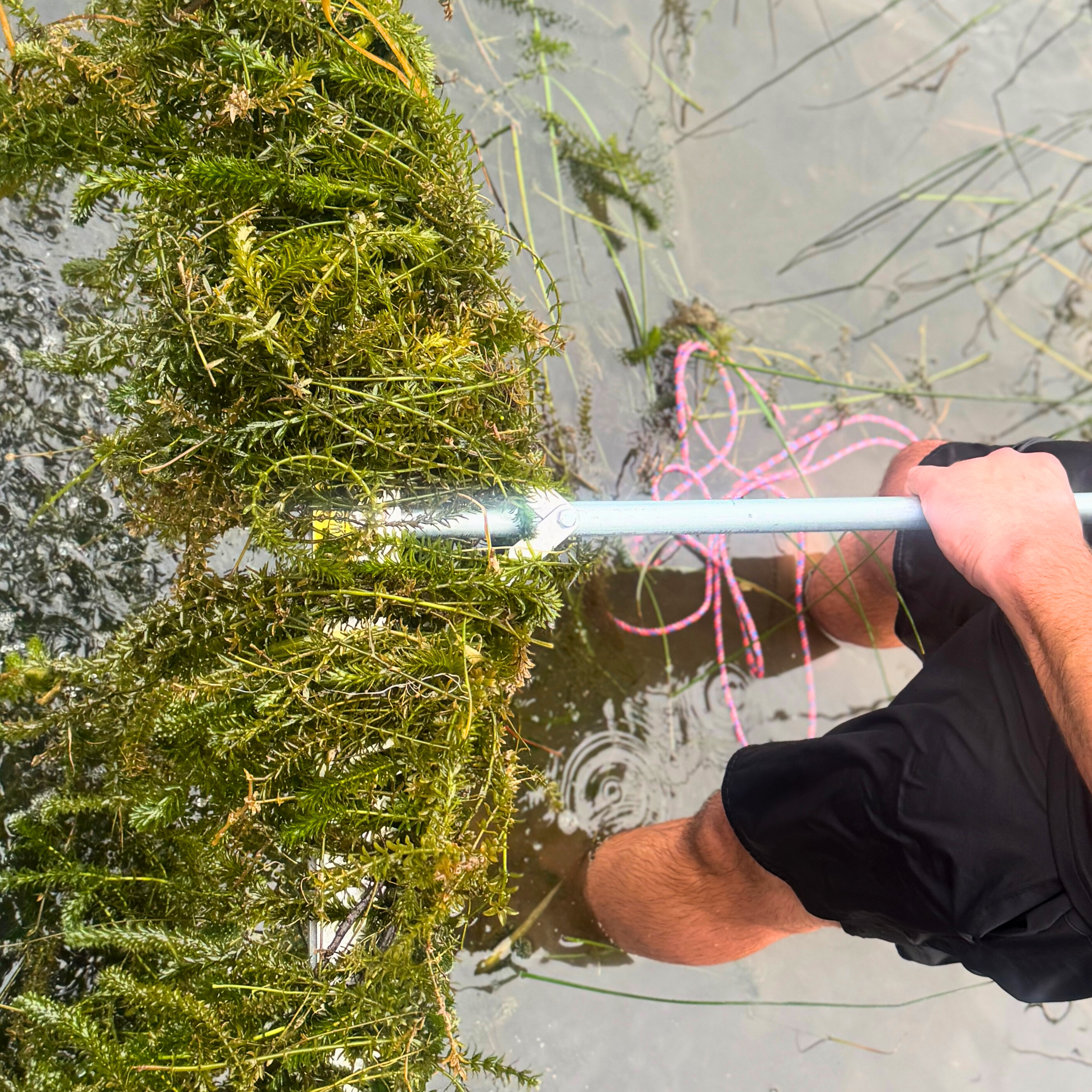
If you've walked your dock on Lake Austin in early March and noticed bright green, fibrous strands tangled through the weed canopy below, you're looking at one of the more misunderstood combinations in Central Texas lake ecology: **Lake Austin Hydrilla** and filamentous green algae growing together. This guide explains what's happening, whether it's safe, and what it means for your waterfront this spring and summer.
---
What Are Lake Austin Weeds Right Now? Identifying Hydrilla and Filamentous Algae
The dominant aquatic weed on Lake Austin is *Hydrilla verticillata*, a state-listed noxious aquatic plant that TPWD has been actively monitoring and managing across the Highland Lakes system. But in late winter and early spring, hydrilla is often visually obscured by a second organism: **filamentous green algae (FGA)**.
That bright, fibrous "moss" wrapped around the hydrilla stems is almost certainly filamentous green algae — species such as *Spirogyra*, *Cladophora*, or mats of periphyton biofilm. It is not true moss. It grows opportunistically on submerged surfaces, including hydrilla canopy, dock pilings, and rocky substrate.
**How to tell them apart:** - **Hydrilla:** Whorled leaves arranged in groups of 4–8 around a central stem; serrated leaf margins; small white tubers in lake sediment - **Filamentous green algae:** Hair-like or cotton-ball texture, bright lime green, no distinct leaves or stems; breaks apart easily into floating mats - **True moss:** Dense, velvety texture; rarely found submerged at significant depth in Texas lakes
For authoritative identification resources, the Texas A&M AgriLife Extension Aquatic Vegetation Management Program and TPWD's Aquatic Invasive Species program both maintain excellent visual identification guides.
---
Why Does Filamentous Green Algae Grow on Lake Austin Hydrilla in Early Spring?
The winter-to-spring transition in Central Texas lakes creates ideal conditions for FGA colonization. Understanding this seasonal dynamic helps explain why **Lake Austin Hydrilla** problems often appear to worsen in spring even when conditions seemed stable through winter.
#
Winter: Hydrilla Slows, Algae Moves In
Hydrilla is a perennial plant with two survival strategies during cold snaps:
1. **Surface canopy dieback:** When water temperatures drop below approximately 10–12°C (50–54°F), hydrilla growth slows dramatically and surface canopy may die back or become sparse. 2. **Root and tuber persistence:** Underground tubers and root crowns remain fully viable in lake sediment through winter. This is why hydrilla cannot be managed by surface removal alone.
When the surface canopy thins, two things happen simultaneously: **water clarity improves** (less shading from dense weed mats) and **nutrients become available** from decomposing plant material. Filamentous green algae are exceptionally well-adapted to exploit exactly this combination — high light, available nutrients, cool but not cold water, and reduced competition from the hydrilla canopy.
By late February and early March on Lake Austin, FGA colonies are often at their most visible: draped over dormant hydrilla stems, coating dock structures, and forming floating mats along calm coves.
#
Spring: Hydrilla Rebounds, But Algae Helped It
As water temperatures rise through March and April, hydrilla begins active regrowth from its tubers and root systems. Here is where the algae-hydrilla interaction becomes ecologically significant:
- **Short-term shading:** Dense FGA mats can temporarily shade hydrilla tip growth, which may slightly slow early-spring emergence in heavily colonized areas. - **Nutrient recycling:** As algae mats die back in warmer temperatures, they decompose and release nitrogen and phosphorus back into the water column — effectively fertilizing hydrilla regrowth. - **Compounding growth cycles:** High nutrient availability from algae decomposition can accelerate hydrilla growth rates in late spring, contributing to the dense canopy that characterizes Lake Austin by May and June.
This nutrient feedback loop is one reason why **Austin lake weed removal** programs that focus only on mechanical cutting — without removing plant biomass from the lake — may unintentionally fuel the next growth cycle.
For detailed seasonal growth data on hydrilla in Texas, the LCRA's Lake Austin Aquatic Vegetation Management Plan and Texas A&M AgriLife's hydrilla management research are valuable references.
---
Is Filamentous Green Algae Toxic? Safety Guide for Swimmers and Pets
This is one of the most common questions we receive about **Lake Austin weeds** in early spring, and the answer requires a distinction.
#
Filamentous Green Algae: Generally Not Toxic
*Spirogyra*, *Cladophora*, and related FGA species are **not inherently toxic**. They are nuisance organisms — visually unappealing and ecologically disruptive — but not the same category of threat as **cyanobacteria (blue-green algae)**, which can produce hepatotoxins and neurotoxins dangerous to humans and animals.
FGA tends to be **bright lime green or yellow-green, fibrous in texture, and forms stringy or cottony mats**. It does not typically form the paint-like surface scum associated with toxic algal blooms.
#
When to Exercise Caution: Practical Safety Checklist
Even though FGA itself is generally benign, use common sense near any dense aquatic growth:
**Avoid swimming or allowing pets to drink if you observe:** - A surface layer that looks like **green, blue-green, or rust-colored paint or pea soup** (possible cyanobacteria bloom) - **Strong rotten-egg, musty, or sewage odor** from the water - **Dead or distressed fish** nearby - **Unusual water discoloration** — brown, red, or orange tints unrelated to tannins - Foam or scum that **clings to surfaces** rather than dispersing
**General precautions around FGA and hydrilla:** - Avoid ingesting clumps of algae or plant material - Rinse pets thoroughly after swimming, especially if they were in dense weed beds - Do not allow pets to drink from areas with visible algae mats or scum - After swimming, shower and rinse swimwear
**Resources for water quality monitoring:** - TPWD Harmful Algal Bloom (HAB) monitoring page - LCRA Water Quality Data
---
Lake Austin Hydrilla Removal: Why Cutting Alone Falls Short
One of the most important things a lakefront property owner can understand about **Lake Austin Hydrilla removal** is the difference between management approaches — and why the method matters as much as the frequency.
#
Lake Austin Hydrilla Cutting: What It Does and Doesn't Do
**Lake Austin Hydrilla cutting** — mechanical or manual severing of stems above the lake bottom — reduces canopy height and temporarily clears a swim area or navigation lane. For short-term aesthetic relief, it works.
However, cutting has documented limitations:
1. **Tubers remain intact.** Hydrilla's underground tuber system, which can produce thousands of new tubers per square meter per growing season according to University of Florida IFAS hydrilla research, is entirely unaffected by stem cutting.
2. **Fragmentation risk.** Cut hydrilla fragments are viable propagules. A single stem node can re-root and establish a new plant. Some cutting approaches, if not carefully executed, can spread fragments into previously uncolonized areas.
3. **Decomposing biomass recycles nutrients.** When cut plant material is left in the lake, it decomposes and releases nutrients that fuel subsequent growth — including the algae growth cycle described above.
4. **Regrowth is rapid.** In warm Texas summers, hydrilla can regrow several inches per day. Without root-level intervention, cutting provides temporary relief at best.
This is consistent with guidance from TPWD's Aquatic Vegetation Management FAQ and peer-reviewed research published through the Aquatic Ecosystem Restoration Foundation.
#
Root-Based Removal + Biomass Export: A More Complete Approach
The alternative — and the approach that addresses the root causes of regrowth — involves:
1. **Root-crown and tuber extraction:** Removing the entire plant including the sediment-level root system and as many tubers as practical, using hand tools or specialized rakes under permit.
2. **Biomass export:** Physically removing all extracted plant material and algae from the lake rather than leaving it to decompose in place.
3. **Algae removal during treatment:** Removing FGA alongside hydrilla, which reduces the nutrient recycling that would otherwise accelerate spring regrowth.
The combination of root-level removal and biomass export directly interrupts the nutrient feedback loop: there is less decomposing material to fertilize the next generation of growth. Over multiple treatment seasons, this approach can meaningfully reduce the density and rate of hydrilla regrowth at a treated site.
Some services focus on canopy cutting without biomass removal. Both approaches are legal under permit, and both have a role in large-scale management programs. For individual property owners seeking durable results, understanding this distinction is worth discussing with any contractor before work begins.
---
What to Ask a Lake Austin Hydrilla Contractor
Before hiring anyone for **Austin lake weed removal**, ask these questions:
- **Are you TPWD and LCRA permitted for aquatic vegetation removal on Lake Austin?** Work without a permit is illegal and can result in fines for the property owner. - **Do you remove biomass from the lake, or leave cut material in place?** Understand what happens to the extracted plant material. - **Do you perform root-level removal, or cut above the sediment?** Ask specifically about tuber management. - **Do you address filamentous algae during treatment?** Algae removal at the same time as hydrilla reduces nutrient recycling. - **Can you show me photos of previous Lake Austin work?** Dock-level and underwater photos indicate actual removal depth. - **What does your permit cover?** Verify the treatment area, approved methods, and any restrictions that apply to your property. - **What do you recommend for long-term maintenance?** A reputable contractor will give you a realistic picture of regrowth timelines.
At Captain Home Services, we are fully permitted for **Lake Austin Hydrilla removal** under TPWD and LCRA, perform root-based extraction, and export all biomass — including algae — from the lake. Contact us for a free assessment of your waterfront.
---
Lake Austin Hydrilla Removal: Seasonal Timing and What to Expect
Understanding when to schedule **Austin lake weed removal** can improve results:
**Late Winter (January–February):** Hydrilla canopy is at its seasonal low. Excellent time for root removal because plants are less dense, visibility is often better, and tubers are concentrated near established root crowns. FGA is beginning to colonize but hasn't reached peak density.
**Early Spring (March–April):** FGA peaks. Hydrilla begins rapid regrowth from tubers as temperatures climb. Ideal window for combined hydrilla and algae removal before summer canopy establishes. Most property owners begin noticing problems again during this period.
**Late Spring / Summer (May–August):** Hydrilla reaches maximum density, often touching the surface in 10–15 feet of water. Most difficult and labor-intensive time for removal. Still effective, but requires more work per linear foot of shoreline.
**Fall (September–November):** Canopy begins thinning again. Good maintenance window for sites treated earlier in the year. LCRA and TPWD permitting timelines should be considered when planning fall work.
For permit guidance, see our Permitting page or the LCRA Permitting Portal.
---
Lake Austin Hydrilla Contractor: How Captain Home Services Approaches Treatment
**Captain Home Services** specializes in manual, root-based **Lake Austin Hydrilla removal** for residential lakefront properties. Our work is conducted under current TPWD Exotic Species Removal Permits and LCRA Aquatic Vegetation Management Permits. We do not use herbicides.
Our standard treatment process:
1. **Site assessment:** We evaluate hydrilla density, depth, algae colonization, and substrate type before quoting. 2. **Permitted removal:** We extract hydrilla including root crowns and accessible tubers by hand using approved tools. 3. **Algae removal:** Filamentous green algae is collected and removed alongside hydrilla biomass. 4. **Biomass export:** All extracted material is transported off the lake — none is left to decompose in the treatment area. 5. **Documentation:** We photograph the site before and after and provide permit documentation for your records.
Most residential projects on Lake Austin are completed in one to two days. View our How It Works page for more detail on the process, or contact us to schedule a free waterfront assessment.
---
Frequently Asked Questions: Lake Austin Hydrilla and Filamentous Algae
#
What is the green fuzzy growth on Lake Austin Hydrilla in early spring?
The bright green, fibrous material growing on or around Lake Austin Hydrilla in late winter and early spring is almost certainly filamentous green algae (FGA) — species such as *Spirogyra* or *Cladophora*. It is not true moss. FGA colonizes hydrilla and other submerged surfaces when water clarity improves and nutrients become available as the hydrilla canopy thins during cold months.
#
Is it safe to swim in Lake Austin near hydrilla and algae?
Hydrilla itself is not toxic to humans. Filamentous green algae is generally not toxic either. However, avoid swimming if you see paint-like surface scum, blue-green or rust-colored discoloration, strong odor, or dead fish nearby — these may indicate a cyanobacteria (blue-green algae) bloom, which can be harmful. Monitor TPWD's Harmful Algal Bloom page for current lake conditions.
#
Can my dog drink water near Lake Austin Hydrilla and algae?
Exercise caution. Filamentous green algae is generally not toxic, but dogs should not be allowed to ingest algae clumps. In any area with visible algae mats or suspicious scum, prevent drinking and rinse your dog thoroughly after swimming. When in doubt, provide clean drinking water from home. The greatest risk comes from cyanobacteria blooms, which can be lethal to dogs at low concentrations.
#
Why does Lake Austin Hydrilla keep coming back after cutting?
Hydrilla regrows from underground tubers that are not affected by stem cutting. A single square meter of lake sediment can contain thousands of viable tubers. Additionally, cut plant material left in the lake decomposes and releases nutrients that fuel regrowth. For durable results, **Lake Austin Hydrilla removal** should target root systems and include extraction of plant biomass from the lake.
#
What permits are required for Lake Austin Hydrilla removal?
Aquatic vegetation removal on Lake Austin requires a permit from TPWD (Texas Parks and Wildlife Department) and compliance with LCRA (Lower Colorado River Authority) Aquatic Vegetation Management Plans. Property owners who hire a contractor should verify the contractor holds current permits for the specific waterbody and removal method. Unpermitted removal can result in fines. See TPWD Aquatic Vegetation Permits and LCRA Permitting for details.
#
What is the difference between Lake Austin Hydrilla cutting and root removal?
**Lake Austin Hydrilla cutting** severs stems above the lake bottom, reducing canopy height temporarily. It does not remove root crowns or tubers, and regrowth typically resumes within weeks during warm months. Root-based removal extracts the plant at or below the sediment surface, reducing the viable tuber population. When combined with biomass export, root removal also interrupts the nutrient recycling that drives algae growth and subsequent hydrilla regrowth.
#
When is the best time to schedule Austin lake weed removal?
Late winter through early spring (January–April) is generally the most efficient window for **Austin lake weed removal** on Lake Austin. Hydrilla canopy is less dense, water clarity is often better, and removing plants before summer regrowth can reduce the severity of peak-season canopy. TPWD and LCRA permit applications should be initiated at least 4–6 weeks before intended treatment.
---
Key Takeaways: Lake Austin Hydrilla and Filamentous Algae in Spring
- The green fibrous growth on **Lake Austin Hydrilla** in early spring is filamentous green algae, not moss — generally not toxic, but worth monitoring - Hydrilla survives winter as tubers; algae colonizes when canopy thins and nutrients are available - Algae decomposition fuels spring hydrilla regrowth — removing algae alongside hydrilla can help reduce this cycle - **Lake Austin Hydrilla cutting** provides temporary relief but doesn't address tubers or nutrient recycling - Root-based removal plus biomass export offers a more complete approach for residential properties - **Austin lake weed removal** requires TPWD and LCRA permits; verify your contractor is fully permitted
---
*Captain Home Services provides permitted, root-based **Lake Austin Hydrilla removal** for residential properties on Lake Austin, Lake Travis, and the Highland Lakes. Schedule a free waterfront assessment or call us at (737) 300-9033. Learn more about our removal process, permitting services, and benthic barrier options.*
---
Related Reading
- Lake Austin Weeds: Complete Hub Guide — overview of all weed species, removal options, and contractor checklist - Lake Austin Hydrilla Management Methods — historical context and management approaches - Understanding Hydrilla: The Most Invasive Aquatic Weed in Austin Lakes - Navigating Permitting for Aquatic Vegetation Removal in Texas - Benthic Barriers: Complete Guide to Lake Bottom Weed Control